
The Rise of Oral Nicotine Pouches: Considerations for the Athlete

Updated: Jun 15
When I think about nicotine use, I think about cigarette smoking, which, in athletics, seems foreign. Yet surveillance testing in professional athletes across multiple sports and over the years have shown that ~15-50% of doping tests revealed nicotine use. (1-3)
But why does this matter to the performance dietitian? One, athletes are asking us about it, especially as nicotine pouches. Two, they’re likening nicotine to caffeine as a stimulant and performance-enhancing supplement. Three, they assume the pouches are safer than smoking.
In this article, I will review:
What nicotine pouches are.
The pharmacokinetics of nicotine.
Nicotine addiction and the how the source of nicotine doesn’t matter.
If nicotine pouches are safe.
Athlete considerations: Heart rate, core temperature, wound healing, cognition, and sleep.
Withdrawal symptoms and timing quitting.

What are Nicotine Pouches?
Nicotine pouches (NP) are small bags of tobacco-derived or synthetically-made nicotine. NP do not contain tobacco. Brand examples include ZYN, On!, and Velo. Pouches are held between the lip and gum typically upwards of 30 minutes. This allows for the buccal transfer of nicotine into the bloodstream.
The Pharmacokinetics of Nicotine
The amount of nicotine in a pouch or cigarette is not the same as to what can enter the bloodstream (i.e., bioavailability), varies by product, and doesn’t always align with what’s advertised on the product’s label.
A single cigarette contains ~10-12 mg nicotine with ~1.2-1.8 mg of that entering the bloodstream once smoked (or ~22-36 mg for a pack of cigarettes). (4) Nicotine from smoking quickly moves across the lungs’ alveoli, making its way across the blood-brain barrier within ~10-20 seconds, and peaking in the bloodstream in ~5-8 minutes. (5,6)
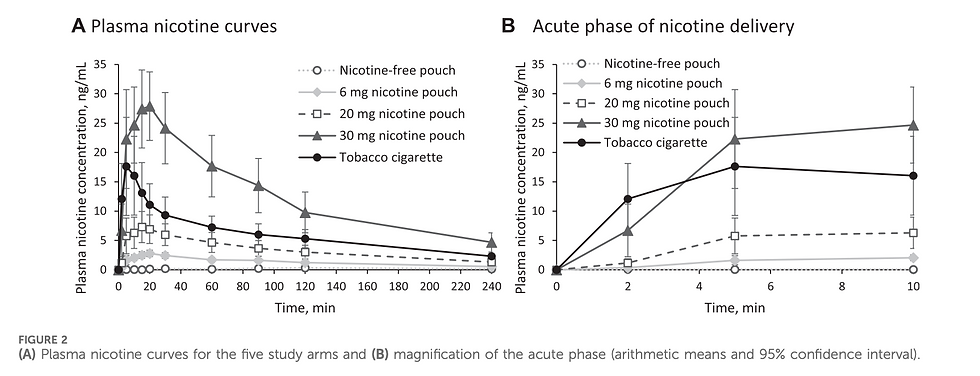
Nicotine from NP relies on slower entry into the blood via buccal absorption, taking ~20-65 minutes to peak in the bloodstream. This range depends on the product’s pH, flavour, nicotine dose, and how long the NP is in the mouth. (6,7) NP doses vary across products, typically ranging from 2-12 mg per pouch. Mallock-Ohnesorg et al. (2024) conducted a five-arm crossover study in human participants, evaluating plasma nicotine differences across a placebo, cigarette smoking, and various NP nicotine contents (6, 20, and 30 mg). They found that:
After 30 minutes in the mouth, ~52% of the nicotine in a 30-mg NP had been extracted—meaning its nicotine content becomes more similar to that of a cigarette.
Extraction aside, NP labels underestimated the true nicotine content by 10-20%.
NP containing 30 mg of nicotine resembled the plasma nicotine curves of cigarettes. (8)
Heshmati et al. (2025) found that both the dose and flavour of NP affected the pharmacokinetics of nicotine. Compared to higher nicotine doses (>8 mg nicotine), lower doses (≤4 mg) had “significantly lower total nicotine exposure and peak concentration” whereas 8-mg NP showed results more comparable to smoking a cigarette. Flavoured NP had significantly higher exposure and peak concentration compared to unflavoured options. (6)
Regardless of nicotine’s delivery, its metabolism in the liver and across products is similar. (6) And similar to alcohol, sex and ethnicity alters nicotine’s metabolism due to enzyme availability. The main enzyme in the liver used for nicotine metabolism is CYP2A6, converting nicotine into cotinine and ultimately 3HC. Asians and African Americans have less of the enzyme, so nicotine is metabolized more slowly than in Caucasians and Hispanics. Women are even more unique: They not only metabolize nicotine faster than men, estrogen-containing oral contraceptives further speed up its metabolism with pregnancy resulting in the fastest metabolism. Faster metabolism means more nicotine use to maintain the same high, which for those wanting to quit, makes it much harder. (9)
Urinary cotinine is how the World Anti-Doping Agency (WADA) monitors nicotine use in athletes, which it began doing so in 2019. However, WADA does not prohibit the use of nicotine. (10) Cotinine is used because its half-life is much longer than nicotine: 2 hours versus 16 hours. (9)
Nicotine targets nicotinic cholinergic receptors (nAChRs) located in the brain and throughout the body, including the cardiovascular system, adrenal glands, neuromuscular junctions, and autonomic ganglia. (2,6,7,11) Downstream from nicotine binding to nAChRs is the release of dopamine and triggering the reward pathway. The more nicotine there is and the more often it’s delivered, the more of that feel-good hormone is released—and that’s where the addiction lies.
The presence of nicotine upregulates nAChRs, so that more receptors are capable of and crave nicotine, but some people are genetically wired to have a greater number of nAChRs prior to ever dosing with nicotine. (5,12)
Nicotine Addiction: The Source of Nicotine Does Not Matter
Even in NP marketed as being tobacco-free, NP still contain nicotine. Your body uses that nicotine the exact same way and it remains highly addictive—and as addictive as cocaine, heroin, and alcohol. (5,7,13) Nicotine has a shorter “high” compared to other drugs, leading to repeat use for a sustained dopamine release and therefore quick addiction. (14)
Advocacy and government websites* state that nicotine addiction can occur in as little as a few days with the occasional use of cigarettes. (5) Oliver & Foulds (2020) found that 35% of those smoking one-to-four cigarettes per day met the DSM-5 criteria for tobacco use disorder—meaning that people with lower intakes still showed signs of moderate or severe clinical addiction. (15) Another concern for NP is that they may be a gateway drug for the use of cannabis, alcohol, and illegal drugs. (16)
Nicotine is also difficult to quit: Roughly 6% of smokers permanently quit every year, but require multiple attempts to do so. (5,14)

*Finding the initial reference on this tidbit was difficult, as they kept referencing each other in a cyclic manner.
Are NP Safe?
Are NP Carcinogenic?
Unlike smoking which is a known carcinogen (and also a risk factor for heart and lung disease), isolated nicotine is not. The tobacco plant contains over 7,000 compounds, to which 70 are considered carcinogenic. (17) The lighting of a cigarette—its combustion—is what allows the transfer of those harmful, tobacco-inherent products into circulation. Additionally, products added to cigarettes compound carcinogen exposure.
When and Why did NP Enter the Marketplace?
In the USA in January 2025, the Food and Drug Administration (FDA) allowed for the marketing and selling of 20 Zyn NP products—a company purchased by tobacco giant Philip Morris International in 2022—in part:
“...due to substantially lower amounts of harmful constituents than cigarettes and most smokeless tobacco products, such as moist snuff and snus, the authorized products pose lower risk of cancer and other serious health conditions than such products. The applicant also provided evidence from a study showing that a substantial proportion of adults who use cigarette and/or smokeless tobacco products completely switched to the newly authorized nicotine pouch products … the FDA found that the applicant showed these nicotine pouch products have the potential to provide a benefit to adults who smoke cigarettes and/or use other smokeless tobacco products that is sufficient to outweigh the risks of the products, including to youth.” (18)
What’s interesting about this statement is the awareness of NP being used to transition a current cigarette smoker towards a safer option due to smoking’s co-morbidities and mortality risk. Smoking rates have declined in both adults and youth over the past few decades. (19)
The FDA also wrote that, “it’s critical that the manufacturer market these products responsibly to prevent youth use.” (18) A survey in U.S. adults by Dowd et al. (2024) found that in those currently using either tobacco cigarettes or e-cigarettes, 68-70% also reported using nicotine pouches because it allowed them to access nicotine in settings where cigarette smoking was not allowed (addiction!). (20) Realistically, NP weren’t designed—or cleared by the FDA—for people to start out of the blue. Yet in younger athletes, this is exactly what I'm seeing.
Without Long-term Safety Data for NP, How Do We Advise Athletes Right Now?
In Sweden, a similar-to-NP product called snus is widely used and does have long-term data. Pronounced "snoos", snus resembles NP in that they’re oral packets and differ in that they contain ground-up tobacco leaves rather than isolated nicotine.
The most recent policy statement from the American Heart Association summarized snus data as follows:
“Most Swedish epidemiological studies have found evidence of increased fatal [myocardial infarction] and stroke but no evidence of accelerated [cardiovascular disease] and stroke among those who use snus compared with those who do not use tobacco.”
“In studies that did report an increased risk of [cardiovascular disease] in those using smokeless tobacco, nearly all found that the magnitude of risk is much less than among those who smoke cigarettes.”
“Smokeless oral nicotine product does not appear to accelerate atherogenesis but does appear to be associated with an increased mortality risk in those with ischemic heart or cerebrovascular disease.” (7)
The other consideration is oral health. When holding a packet in between the lip and gum often multiple times per day, those packets also contain sugar and/or their sweetener alternatives, flavours, microplastics, and other ingredients that can affect the oral cavity. Any risk for oral cancer may tie back to what else exists in the NP. (7)
What’s in it for the Athlete?
Nicotine’s Effects on Heart Rate, Core Temperature, and Wound Healing
As a stimulant, a side effect of nicotine is vasoconstriction and leading to changes in heart rate. Most often, I notice athletes using NP containing doses under 10 mg nicotine per pouch. In the Mallock-Ohnesorg et al. (2024) paper, the 6 mg NP resulted in an increased heart rate of ~5 beats per minute within the first ~10 minutes of use and returned to baseline in ~60 minutes. (8) It isn’t a large increase and in those consistently dosing with nicotine, heart rates remain elevated throughout the day compared to non-users. (7)

Nicotine consumption via lozenges or smoking has been found to increase core body temperature upwards of ~0.2°C compared to zero nicotine. (21) In a study by Moyen et al. (2024), they found that 7 mg nicotine via a transdermal patch compared to a placebo increased core body temperature by ~0.4°C after a 60-minute cycle followed by a time trial while having access to water ad libitum. Nicotine use increased core and skin temperature, reduced blood flow to the skin, and ultimately increased thermal strain and the risk for exertional heat injury. Given this study's use of a transdermal patch, the researchers noted that the slower nicotine delivery from a NP may have lessened effects on core and skin temperatures during exercise. (21)
And with less blood flow to the skin, wound healing may also be delayed. This is especially concerning since nicotine use isn’t once daily, but tends to be steadily consumed throughout the day. (22) The wound is therefore not getting a break from steady nicotine exposure.
Does Nicotine Use Improve Cognition?
In a previous article, I wrote about choline (and alpha-GPC) and how studies measure cognition in athletes (e.g., lab versus field tests, different cognitive tests being used that make it hard to compare across studies, what aspect of cognition is being measured). And even if nicotine via cigarette smoking could show a benefit, it wouldn’t be ethical to ask an athlete to start smoking.
Speaking of translation, what populations are known to benefit from nicotine and cognition? Nicotine and nicotinic agents have been shown to improve cognitive and attention deficits in those with ADHD, Alzheimer’s disease, Parkinson’s disease, schizophrenia, and age-related cognitive decline. (23) These are not the same populations as young, healthy athletes. So what does exist in this population?
Fang et al. (2022) evaluated 13 male baseball players at the National Taiwan University of Sport. Having chewed 2 mg nicotine gum, researchers found significant improvements in the players' reaction time and how long it took them complete a cognitive test. (11) Neither cognitive tests used in this study were within-sport or game activity, but were tests easily conducted in a standardized way.
Blank et al. (2007) evaluated how attention and working memory are affected by caffeine and nicotine in non-smokers consuming less than 200 mg caffeine daily. The rounds of testing utilized different doses per intervention: caffeine anhydrous capsules containing 75mg or 150mg caffeine (or a placebo) and nicotine gum chewed for 15 minutes (2mg or 4mg nicotine). The researchers found that “nicotine produced effects that were independent of caffeine dose and were reliable across session days.” (This plays into how nicotine and caffeine target different receptors and therefore have different downstream effects.) There was minimal evidence for cognitive improvements. Reaction time did show an enhancement with nicotine, which is comparable to previous studies, although other studies have found no improvement. (24)
The meta-analysis by Heishman, Kleykamp, and Singleton (2010) found “significant positive effects of nicotine or smoking on six domains: fine motor, alerting attention-accuracy and [response time; RT], orienting attention-RT, short-term episodic memory-accuracy, and working memory-RT.” Within this meta-analysis, non-smokers and smokers were used and nicotine dosing was not from NP, but rather gum, transdermal patches, nasal spray, tobacco cigarettes, inhaler, or an injection. (23)
The review by Chague et al. (2015) summarized the following:
“Nicotine significantly improved fine motor abilities, alerting attention-accuracy and response time, and orienting attention-response time.”
Reaction, movement, and anticipation times in smokeless tobacco users were similar to non-users. However, the ability to face cognitively-challenging tasks, manage stressful situations, and experience less anxiety was better in smokeless tobacco users. (2)
Interpreting participants (nicotine users versus the nicotine naïve), nicotine delivery (smoking cigarettes versus nicotine patches versus NP), and dose are all important when translating nicotine and cognitive research into your practice.
Sleep
Both nicotine and caffeine are stimulants, so be mindful when timing intakes and potential sleep disturbances. (25) Often when athletes report being unable to fall asleep, one of the factors practitioners jump to is caffeine intake and timing—yet nicotine seems to be ignored.
When is it a Good Time to Quit?
When considering withdrawal, concerning symptoms include restlessness, depressed mood, irritability, increased anxiety or stress, insomnia, difficulty concentrating, and slowed reaction time. (9,26)
The systematic review and meta-analysis by Bao et al. (2024) evaluated nicotine users in studies who either maintained or ceased nicotine use from cigarettes. They found that poor performance outcomes occurred in the first 24-48 hours of withdrawal, but rebounded after 48 hours. (26)
Attempting to quit in season is therefore reasonable. Given the nicotine addiction strengthens the longer someone uses, avoiding any delays will make it easier for the athlete to quit.
Key Take-Aways: Nicotine is Not Harmless
Isolated nicotine is not a carcinogen and is a safer alternate for someone who already smoke. However, it remains wildly addictive.
What should you as the practitioner do?
If aiming to introduce a stimulant, caffeine is a safer alternative that has much more research on dosing and safety, without the high dependency that nicotine has. Caffeine targets a different receptor, so its downstream cognitive effects are not exactly the same as nicotine.
Educate athletes and the medical team that NP aren’t designed for nicotine-naïve athletes to start—they’re meant for transitioning away from more risky tobacco products.
Ensure athletes are screened for any nicotine use—not simply cigarette smoking. This helps the medical team understand who is potentially at greater risk in warmer environments, as a consideration when athletes report sleep disturbances, and for those with any wounds (e.g., the post-surgical period).
The literature on nicotine use and its effects in athletes is sparse, showing a mix of benefit or nil effects across various cognitive parametres.
References
(1) Zandonai, T., Botrè, F., Abate, M.G., Peiró, A.M., & Mündel, T. (2023). Should we be concerned with nicotine in sport? Analysis from 60,802 doping control tests in Italy. Sports Med,53(6):1273-9. https://pubmed.ncbi.nlm.nih.gov/36826714/
(2) Chagué, F., Guenancia, C., Gudjoncik, A., Moreau, D., Cottin, Y., & Zeller, M. (2015). Smokeless tobacco, sport and the heart. Arch Cardiovasc Dis,108(1):75-83. https://pubmed.ncbi.nlm.nih.gov/25497687/
(3) Marclay, F., Grata, E., Perrenoud, L., & Saugy, M. (2011). A one-year monitoring nicotine use in sport: frontier between potential performance enhancement and addiction issues. Forensic Sci Int,213(1-3):73-84.https://pubmed.ncbi.nlm.nih.gov/21719221/
(4) Tobacco Stops with Me. (2026, May 27). How much nicotine is in tobacco products? https://stopswithme.com/how-much-nicotine-is-in-tobacco-products/
(5) Tobacco Stops with Me. (2026, January 5). How long does it take to get addicted to nicotine?https://stopswithme.com/how-long-does-it-take-to-get-addicted-to-nicotine/
(6) Heshmati, J., Bates, E.L., Shahen, S., Visintini, S., Quirouette, E., … & Mir, H. (2025). Nicotine pouch pharmacokinetics compared to smoked tobacco: a systematic review and meta-analysis. Drug Alcohol Depend Rep,17:100389. https://pubmed.ncbi.nlm.nih.gov/41246258/
(7) Himmelfarb, C.R.D., Benowitz, N.L., Blank, M.D., Bhatnagar, A., Chase, P.J., … & Whitsel, L.P. (2025). Impact of smokeless oral nicotine products on cardiovascular disease: implications for policy, prevention, and treatment: a policy statement from the American Heart Association. Circulation,151(1):e1-e21. https://pubmed.ncbi.nlm.nih.gov/39624904/
(8) Mallock-Ohnesorg, N., Rabenstein, A., Stoll, Y., Gertzen, M., Rieder, B., … & Rüther, T. (2024). Small pouches, but high nicotine doses—nicotine delivery and acute effects after use of tobacco-free nicotine pouches. Front Pharmacol,15:1392027. https://pubmed.ncbi.nlm.nih.gov/38841367/
(9) Benowitz, N.L. (2009). Pharmacology of nicotine: addiction, smoking-induced disease, and therapeutics. Annu Rev Pharmacol Toxicol,49:57-71. https://pubmed.ncbi.nlm.nih.gov/18834313/
(10) World Anti-Doping Agency. (n.d.). Nicotine, exercise and heat stress: performance benefits, health risks and implications for the prohibited list. https://www.wada-ama.org/en/resources/scientific-research/nicotine-exercise-and-heat-stress-performance-benefits-health-risks
(11) Fang, S.-H., Lu, C.-C., Lin, H.-W., Kuo, K.-C., Sun, C.-Y., … & Chang, W.-D. (2022). Acute effects of nicotine on physiological responses and sport performance in healthy baseball players. Int J Environ Res Public Health,19(1):515. https://pubmed.ncbi.nlm.nih.gov/35010774/
(12) Quit. [QuitOrgAuVic]. (2017, November 22). How does nicotine work [Video]. YouTube. https://www.youtube.com/watch?v=PqeEGpCQhBA
(13) National Institute on Drug Abuse. (2020, January). Tobacco, nicotine, and e-cigarettes research report: is nicotine addictive? https://nida.nih.gov/publications/research-reports/tobacco-nicotine-e-cigarettes/nicotine-addictive
(14) Kolla, J. (n.d.). Caffeine and nicotine. UC Santa Barbara Health and Wellness. https://wellness.ucsb.edu/challenges/sleep-challenge/ucsb-sleep-challenge/caffeine-and-nicotine
(15) Oliver, J.A., & Foulds, J. (2020). Association between cigarette smoking frequency and tobacco use disorder in U.S. adults. Am J Prev Med,60(5):726-8. https://pubmed.ncbi.nlm.nih.gov/33358276/
(16) CAMH. (n.d.). Nicotine dependence. https://www.camh.ca/en/health-info/mental-illness-and-addiction-index/nicotine-dependence
(17) American Cancer Society. (2024, November 19). Harmful chemicals in tobacco products. https://www.cancer.org/cancer/risk-prevention/tobacco/carcinogens-found-in-tobacco-products.html
(18) U.S. Food & Drug Administration. (2025, January 16). FDA authorizes marketing of 20 ZYN nicotine pouch products after extensive scientific review. https://www.fda.gov/news-events/press-announcements/fda-authorizes-marketing-20-zyn-nicotine-pouch-products-after-extensive-scientific-review
(19) American Lung Association. (2026, March 10). Overall smoking trends. https://www.lung.org/research/trends-in-lung-disease/tobacco-trends-brief/overall-smoking-trends
(20) Dowd, A.N., Thrul, J., Czaplicki, L., Kennedy, R.D., Moran, M.B., & Spindle, T.R. (2024). A cross-sectional survey on oral nicotine pouches: characterizing use=motives, topography, dependence levels, and adverse events. Journal,26(2):245-9. https://pubmed.ncbi.nlm.nih.gov/37712111/
(21) Moyen, N.E., Barnes, M.J., Perry, B.G., Fujii, N., Amano, T., … & Mündel, T. (2024). Nicotine exacerbates exertional heat strain in trained men: a randomized placebo-controlled, double-blind study. J Appl Physiol (1985),137(2):421-8. https://pubmed.ncbi.nlm.nih.gov/38961822/
(22) Mündel, T. (2017). Nicotine: sporting friend or foe? A review of athlete use, performance consequences and other considerations. Sports Med,47(12):2497-2506. https://pubmed.ncbi.nlm.nih.gov/28791650/
(23) Heishman, S.J., Kleykamp, B.A., & Singleton, E.G. (2010). Meta-analysis of the acute effects of nicotine and smoking on human performance. Psychopharmacology (Berl),210(4):453-69. https://pubmed.ncbi.nlm.nih.gov/20414766/
(24) Blank, M.D., Kleykamp, B.A., Jennings, J.M., & Eissenberg, T. (2007). Caffeine’s influence on nicotine’s effects in nonsmokers. Am J Health Behav,31(5):473-83. https://pubmed.ncbi.nlm.nih.gov/17555378/
(25) UCSF Health. (n.d.). Nicotine dependence. https://www.ucsfhealth.org/care/conditions/nicotine-dependence
(26) Bao, K., Zheng, K., Zhou, X., Chen, B., He, Z., & Zhu, D. (2024). The effects of nicotine withdrawal on exercise-related physical ability and sports performance in nicotine addicts: a systemic review and meta-analysis. J Int Soc Sport Nutr,21(1):96-116. https://pubmed.ncbi.nlm.nih.gov/38213003/


