
High Intakes of Unprocessed Red Meat in Athletes: Whole Foods or Troublesome?

Updated: Apr 28
Over the past few months, I’ve noticed a boy dinner-esque meal emerge: the pound or half-pound of ground beef dinner, usually mixed with rice and vegetables. At first, I thought it may be related to a lack of cooking skills, maybe the ongoing obsession with protein, or maybe… disordered eating as it pertains to body image, “getting cut”, and the looksmaxxxing trend taking over social media.
In this blog, I’m going to review:
Daily protein intakes for athletes and how this translates to serving sizes of proteins.
Differentiating between red meat and unprocessed meat, plus how they affect health outcomes.
Dosing recommendations for unprocessed red meat.
Reassessing body image and disordered eating in male athletes.
Protein Intakes: What’s Recommended? What is a Serving of Protein?
Various researchers have different takes on what the recommended protein dose for healthy athletes is, but there seems to be agreement around an upper threshold of ~1.6 grams per kilogram body weight per day (g/kg). Bodybuilding and competition prep, weight declines, and injuries and surgeries often warrant higher levels.
When it comes to what’s on your plate, teaching methods can include envisioning a portion of protein as:
The size of a deck of cards: This is ~3 ounces of protein (1 ounce of protein = ~7-8 grams protein).
The size and thickness of the palm of the athlete’s hand: This will vary greatly, but it’s an attempt to individualize a larger player’s needs with a larger portion size.
Using a food scale: The least practical option for most athletes and most scenarios..
Using the 1.6 g/kg/day guideline for a 220-pound athlete consuming 3,000 kcal/day, below is a breakdown for how much of that daily protein is derived from that pound of meat alongside saturated fat intakes. Regarding the former, in my experience those same athletes are not compensating their protein intakes throughout the day. Often, they're consuming well beyond the recommended daily protein goal--and replacing other nutritive foods to do so and to avoid being in a calorie surplus.
Daily Protein & Saturated Fat Considerations | 1.6 g/kg Meal Plan |
Daily protein total | 160 g |
Percentage of daily protein intake met by one pound of ground beef* | 63% (~100 g protein/pound of beef) |
Percentage of daily saturated fat intake met by one pound of ground beef** | 42-70%** |
*One pound (~454 grams) of this contains ~100 grams of protein and 14 grams saturated fat, assuming a 95% protein and 5% fat mix.
**The American Heart Association recommends limiting daily saturated fat intake to no more than 6% of total calories, whereas Health Canada and the 2025 Dietary Guidelines Advisroy Committee recommends limiting to 10%.
Unprocessed Red Meat and Processed Meat in General: Carcinogen Ratings
Defining Red Meat and Understanding Colorectal Cancer
The American Cancer Society defines red meat as beef, pork, veal, lamb, mutton, and goat. (1) They state that “red meat is a probable carcinogen”—especially of the colon and rectum, and possibly the prostate—which was the recommendation of the World Health Organization’s International Agency for Research on Cancer (IARC) back in 2015. (2) IARC classified unprocessed red meat as a probable carcinogen (Group 2A) and processed meat as carcinogenic to humans (Group 1). (3)
Regarding the Group 2A recommendation, a main concern was the increasing prevalence of a population’s intake of red meat (i.e., greater frequency and/or larger daily doses), especially within developing countries. Colorectal cancer (CRC) risk typically increases with age, especially after 50 years. However, 20% of new diagnoses of CRC are in those under the age of 55 years--a risk increasing in this age cohort at a rate of 3% annually. Modifiable risk factors include physical activity, obesity, smoking, alcohol, and diet. (4)
Everything we consume by mouth interacts with the entire length of the gastrointestinal tract, from mouth to anus. The gut lining is highly sensitive to the outside world, so it makes sense that exposure to certain doses and frequencies of carcinogens can be troubling.
Why is Red Meat and All Processed Meat Tied to Cancer Risk?
Typically, processed meats like bacon, deli meats, hot dogs, and other cured meats get the bad rap. They contain added nitrates, nitrites, high levels of sodium, and often higher levels of total and saturated fat. When nitrates and nitrites interact with heat, as you would when cooking bacon, nitrosamines are produced. These can then interact with the body’s DNA and lead to cancerous formations. Yet when nitrates and nitrites in the absence of heat (as in deli meats) are in the colon, they can still produce compounds that affect the cellular DNA. You can read more about this here.
But what about unprocessed red meat? Often, it’s seen as a whole food or natural option. However, the concern lies in red meat’s high heme iron content. Bingham et al. (2002) conducted highly-controlled, crossover, metabolic ward studies. Holding the dietary fiber and fat intakes constant across participants, the different dietary protocols included:
Ten days each of participants consuming 60 grams red meat (as beef and pork), 600 g red meat, and 600 g white meat (chicken, turkey, white cod).
Similar to the above protocol, but the 600 g was replaced with 420 g of red or white meat. Each protocol lasted for 15 days.
Fifteen days each of 60 g and 120 g red meat. (5)
Fecal samples were collected to evaluate apparent total N-nitroso compounds (ATNCs and NOCs), which are formed in the colon. Colonic bacteria decarboxylate amino acids to form amines and amides, which can then be transformed to NOCs in the presence of a nitrosating agent. Given meat intake “increases the level of nitrogenous residues reaching the colon … meat might be expected to increase [the] colonic level of NOCs.” (5)
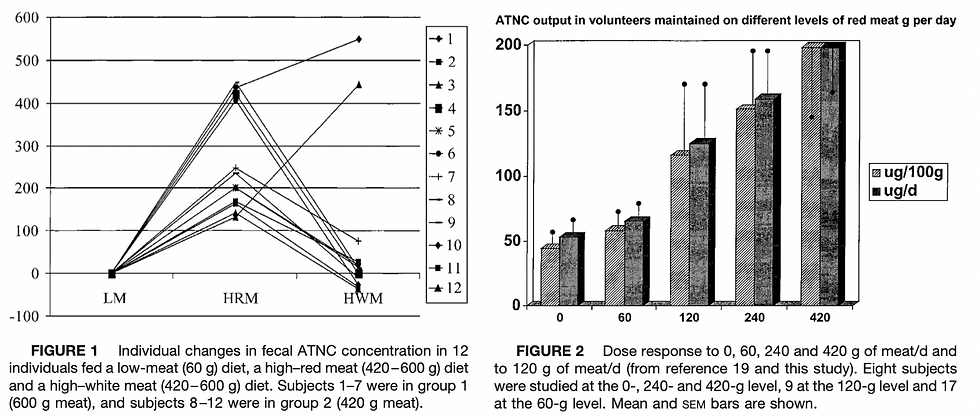
Figure 1 shows that 60 grams of red meat (LM) and 420-600 grams of white meat (HWM) had minimal effects on fetal ATNC concentrations. Figure 2 shows a dose-response to increasing intake levels of red meat and fetal ATNC outputs. Bingham et al. (2022) wrote that “at the higher levels of meat consumption, concentrations of ATNCs are of the same order of magnitude as the concentration of tobacco-specific NOCs in cigarette smoke.” (5) Remember that smoking is a modifiable risk factor for CRC. (4)
Keep in mind that this study also held fiber intakes constant across the dietary interventions—meaning fiber did not protect against increasing red meat doses and their increasing fecal ATNC productions. The primary indicator of ATNC levels was the daily dose of red meat.
Dosing Red Meat: How Much is Too Much?
Lescinsky et al. (2022) found a very weak relationship between unprocessed red meat intake and increased CRC risk at doses of 50 or 100 grams daily. (6) Combined with the Bingham et al. (2002) research, possibly 100 grams per day (or ~3.3 ounces) is the max dose where CRC risk is mitigated.
The Scientific Advisory Committee on Nutrition out of the United Kingdom in 2010/11 specifically recommended capping red meat intake to 70 grams per day, or ~2.5 ounces. (7) In 2023, the Food and Agriculture Organization of the United Nations reported that “synthesized findings from risk analyses show that consumption of modest amounts of unprocessed red meat (ranging from 9 to 71 g/day) has minimal health risk. For processed red meat, however, very low levels of consumption can elevate risk of mortality and chronic disease outcomes, including cardiovascular disease and [CRC].” (8)
Neither Canada nor the USA has specific dosing recommendations. The 2025 Dietary Guidelines Advisory Committee (the USA's pre-cursor to the Dietary Guidelines for Americans) recommended to “lower” one’s intake of both red and processed meats. (9) For Canada, their wording choice is to include “lean red meat including wild game”, to consume plant-based proteins more often, and to have “lower intakes” of processed meats. (10)
Epidemiological studies have found varying relationships with health outcomes, including CRC, including no difference between high and low doses (in contrast to Bingham’s group). However, the Sigma Nutrition Radio podcast (episode 600), walked through this exact research question and reminded listeners that when reviewing the methodology section of papers, clarifying dosing groups when making comparisons across study outcomes is important. For instance, given the higher group in the Bingham study was defined anywhere between 120-600 grams, this doesn't fairly compare to other studies where the high group was defined as 70 grams.
What are the Health Benefits of Red Meat?
This isn’t a hit article on red meat. I’m highlighting how there seems to be a max daily dose to lower one’s health risk.
Messaging from red meat advocates often highlight red meat (as beef) as an excellent source of iron, zinc, selenium, and the B vitamins—all very much true. The Cattlemen’s Beef Board and National Cattlemen’s Beef Association has a great resource that shows the nutrient values per 3-ounce serving of various cuts based on a 2,000-kcal diet and the Daily Values.
Red meat proponents are correct in that the food can be a highly nutritive option. Researchers are also correct in that daily total red meat intake should be limited. Both positions can be true at the same time.

Evaluating Body Image and Disordered Eating in Male Athletes
A reminder to you as the practitioner assessing body image concerns in athletes: Men often use the words fit, jacked, lean, cut, huge, or diced rather than the traditional female terminology of skinny, toned, lean, slim, or light. Body image concerns still exist in males and we have to find ways to screen them appropriately. Read here about choosing an appropriate screener for body image, disordered eating, or eating disorders in your male or female athlete population(s).
My curiosity used to spike when a female athlete would tell me they’re new to being a vegan or recently cut out all gluten. Yet, I feel like I’ve been conditioned to a male athlete when they say they’re focusing on protein. At what point is a high-protein, lower-in-everything-else diet no longer a concern for food restriction, disordered eating, or body image concerns?
In these instances, if you ask a male athlete to reduce their protein portions and (often) increase their carbohydrate intake, but their response is that they’ll gain weight, carbs aren’t healthy, or something not truly health- or performance-oriented, take pause.
Not every male athlete who walks into your office interested in a higher-protein intake has malicious intent. Practitioners should lean in a bit more, challenge the nutrition content they’re hearing on podcasts and from one another, and test to see if the athlete is willing to soften their meal plan—or dig their heels in. Practitioners are then evaluating intent for the higher-protein intake: is it a healthy, misguided, or problematic approach?
Key Takeaways
Taken together with epidemiological and intervention studies, the key point here is that unprocessed red meat can be included in a healthy diet when the daily intake remains below ~100 grams (or roughly the size of a deck of cards). And a reminder that red meat isn't specifically beef.
What the research does not support:
A total daily intake of unprocessed red meat totaling more than ~100 grams is benign.
An otherwise healthy diet rich in fiber and other plant sources offsets excessive unprocessed red meat intake.
Unprocessed red meat is OK because it contains micronutrients.
What can we do as practitioners?
Whether you're a practitioner who provides meal plans, controls menu planning for a team, or are the middle person between an athlete and a private chef, weave this knowledge into your work. So many of us as practitioners have a good amount of control over player intakes of meat and saturated fat.
Better educate (male) athletes on consuming less processed meats and unprocessed red meats, working to support the intake of unprocessed poultry, seafood, eggs, and plant protein sources.
Remind athletes that simply because they meet their fruit, vegetable, and fibre goals doesn’t mean they have a free pass to eat endless amounts of red meat.
If the athlete fears weight gain when you work to add in carbohydrates, remind them that the goal is to carve out room on their plate for carbs—replacing the calories from their once-larger portions of protein.
References
(1) American Cancer Society medical and editorial content team. (2025, October 20). Red and processed meat and cancer. American Cancer Society. https://www.cancer.org/cancer/risk-prevention/diet-physical-activity/how-diet-and-physical-activity-impact-cancer-risk/red-meat-and-cancer.html
(2) IARC Working Group on the Evaluation of Carcinogenic Risks to Humans. (2018). Red meat and processed meat, IARC monographs on the evaluation of carcinogenic risks to humans. World Health Organization International Agency for Research on Cancer. https://publications.iarc.who.int/Book-And-Report-Series/Iarc-Monographs-On-The-Identification-Of-Carcinogenic-Hazards-To-Humans/Red-Meat-And-Processed-Meat-2018
(3) National Cancer Institute Cancer Trends Progress Report. (2025, April). Red meat and processed meat consumption. https://progressreport.cancer.gov/prevention/diet_alcohol/red_meat
(4) McDonald, K. (2026, March 2). Colorectal cancer rates are skyrocketing in young adults—is your lifestyle putting you at risk? Cancer Research Institute. https://www.cancerresearch.org/blog/colorectal-cancer-awareness-month
(5) Bingham, S.A., Hughes, R., & Cross. A.J. (2002). Effect of white versus red meat on endogenous N-nitrosation in the human colon and further evidence of a dose response. J Nutr,132(11 Suppl):3522S-3525S. https://pubmed.ncbi.nlm.nih.gov/12421881/
(6) Lescinsky, H., Afshin, A., Ashbaugh, C., Bisignano, C., Brauer, M., … & Murray, C.J.L. (2022). Health effects associated with consumption of unprocessed red meat: a burden of proof study. Nat Med,28(10):2075-82. https://pubmed.ncbi.nlm.nih.gov/36216940/
(7) Scientific Advisory Committee on Nutrition. (2010). Iron and health. Public Health England. https://www.gov.uk/government/publications/sacn-iron-and-health-report
(8) Food and Agriculture Organization of the United Nations. (2023). Contribution of terrestrial animal source food to healthy diets for improved nutrition and health outcomes.https://openknowledge.fao.org/items/aee31ec6-7641-47ea-80f5-8de49e87e708
(9) 2025 Dietary Guidelines Advisory Committee Membership. (2025). Scientific report of the 2025 Dietary Guidelines Advisory Committee. United States Department of Agriculture. https://www.dietaryguidelines.gov/2025-advisory-committee-report
(10) Health Canada. (2019). Canada’s dietary guidelines. https://food-guide.canada.ca/en/guidelines/


